
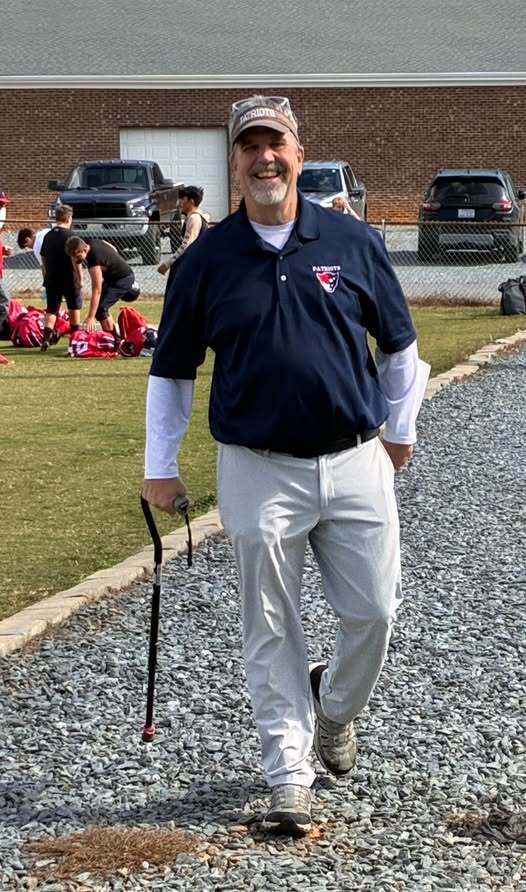
A former Northeastern Randolph Middle School football coach returns to the sidelines, proving that the desire to serve, encourage and make a difference is stronger than the challenges of Parkinson’s disease.
For one former Northeastern Randolph Middle School football coach, David Ritter, returning to the sidelines this season was about much more than football. It was an opportunity to reconnect with students, fellow coaches and a community that has meant so much to him over the years.
It was also a reminder that while Parkinson’s disease can change many things, it does not have to take away a person’s purpose.
“I was fortunate enough to help coach the Northeastern Randolph Middle School football team from 2016 through 2021,” he shared. “After taking several years off, I decided to come back and help again this year. I missed being around the kids, the coaches and the game.”
That connection to the game and its players made returning to the Northeastern Randolph Patriots a meaningful experience. Football offers young athletes lessons that extend well beyond the field, including teamwork, perseverance, discipline and the importance of supporting one another.
For this coach, being part of that process has always been rewarding. This season, however, brought some unexpected challenges.
Parkinson’s disease is often associated with physical symptoms such as tremors, stiffness and balance difficulties. But the disease can also affect cognitive processing, making it more difficult to think quickly, manage multiple tasks and respond to rapidly changing situations.
One of the symptoms he experienced is called bradyphrenia, or slowness in thinking.
On a football field, where players ask questions, coaches communicate, plays are discussed and adjustments happen in real time, the ability to process information quickly is essential. Although he knows the game and understands what needs to be done, Parkinson’s can sometimes make it harder to keep pace with everything happening around him.
That reality can be frustrating, particularly when everyday tasks that once came naturally require more time and effort.
Parkinson’s can affect more than a person’s physical abilities. It can also influence communication, problem-solving and confidence. For someone who remembers how easily those things once came, adjusting to those changes can be difficult.
Yet Coach Ritter's decision to return to coaching reflects a determination that reaches beyond those challenges.
Rather than allowing Parkinson’s to define what he can no longer do, he continues to focus on the opportunities he still has to make a difference.
He recognizes that the disease has taken a great deal from him. In another unexpected way, it has also created opportunities he might not otherwise have experienced. Had he continued working, he may never have had the chance to return to a sport and community that mean so much to him.
His time with the Northeastern Randolph Patriots this season has been a reminder of the value of showing up, staying connected and continuing to contribute, even when circumstances are not easy.
His experience also offers an important lesson for students: Strength is not simply about what a person can do without difficulty. Sometimes, strength is choosing to keep going when things become harder than they used to be.
For the young athletes he has helped coach, that lesson may prove just as valuable as anything learned during a practice or a game.
RItter's message is one of perseverance, gratitude and determination. Parkinson’s may change the way he approaches challenges, but it has not taken away his desire to help others or be part of something bigger than himself.
As he looks ahead, he remains committed to doing what he can for as long as he can.
“Because Parkinson’s may change how I do things, but it doesn’t get to decide whether I keep trying.”
And that is a message worthy of the Northeastern Randolph Patriots and the entire Randolph County School System.
Never quit. Always fight.